Fairy Tales With a Modern Twist: The Children's Book Today
- Why fairy tales never go out of style
- What changes in the modern fairy tale?
- The right modern fairy tale for every age
- 1 to 3 years: safety and repetition
- 3 to 5 years: imagination in full bloom
- 6 to 8 years: nuance and opinions
- The ultimate modern fairy tale: your child as the hero
- Modernising fairy tales at the kitchen table
- How to spot a truly good modern fairy tale
- The magic stays, the message grows
There is something enchanting about the moment your child listens breathlessly to a fairy tale. Eyes wide, blanket pulled up to the chin, and that one question that always returns: "And then what?" Fairy tales have been around for centuries, but the stories many of us grew up with can feel a little off-key today. A princess who waits passively to be rescued? A witch who is wicked simply because she is old and lives alone? Today's parents read those messages differently, and thankfully the shelves are changing to match.
Here I want to look at how classic fairy tales are being retold for children now, what developmental psychology tells us about why fairy tales still matter, and how you can choose (or even invent) the very best versions.
Why fairy tales never go out of style
The psychoanalyst Bruno Bettelheim argued in his classic The Uses of Enchantment that these stories help children process inner fears. A big bad wolf, a dark forest, a child who seems lost: these are symbols for feelings that toddlers and preschoolers cannot yet put into words. By living alongside a hero who overcomes danger, a child learns that hardship can be survived.
Developmental psychologist Jean Piaget described how children between roughly two and seven live in a stage of magical thinking. Talking animals, magic wands and spells fit seamlessly with the way they see the world. Fairy tales feed that imagination at exactly the right moment.
What also makes fairy tales unique is their clear structure. There is a beginning, a challenge, and a resolution. That predictability gives children something to hold onto, while the suspense provides just enough of a thrill. No wonder we keep passing these stories down, generation after generation.
What changes in the modern fairy tale?
The modern fairy tale keeps the magic but polishes the message. The changes are subtle yet meaningful, and they reflect how we think about children, roles and emotions today.
- Active heroes instead of passive ones. Where the classic princess waited to be saved, the modern heroine solves her own problem. Think of girls who venture into the forest, outwit dragons with cleverness, or rule their own kingdoms. Boys, too, are allowed to be vulnerable, to feel scared, and to ask for help.
- More nuanced villains. Many retellings give the antagonist a backstory. Why is the witch so angry? What made the wolf so lonely? This teaches children that behaviour has causes, a first small step toward empathy.
- Diversity and recognition. Modern fairy tales feature children of different skin tones, family shapes and backgrounds. Every child deserves to see themselves reflected in a story.
- Gentler, reassuring endings. The gruesome details of the original Brothers Grimm versions (chopped-off toes, children abandoned in the woods) are often softened or left out for young readers.
- Emotional literacy. Characters name what they feel. "I was scared, but then I found my courage" gives children language for their own emotions.
One important thing to remember: modernising does not mean flattening everything. A good modern fairy tale keeps real suspense and real danger, because that is precisely what makes the victory meaningful. The art lies in the balance.
The right modern fairy tale for every age
Fairy tales are not one-size-fits-all. What fascinates a preschooler bores an eight-year-old, and what soothes a baby means nothing to a six-year-old. Here is an age guide you can lean on when choosing.
1 to 3 years: safety and repetition
Choose sturdy board books with short, rhythmic sentences and plenty of repetition. At this age everything revolves around the pleasure of sound and recognising familiar pictures. A simplified Three Little Pigs with a funny, non-scary wolf works beautifully. Let your child point along and imitate the noises.
3 to 5 years: imagination in full bloom
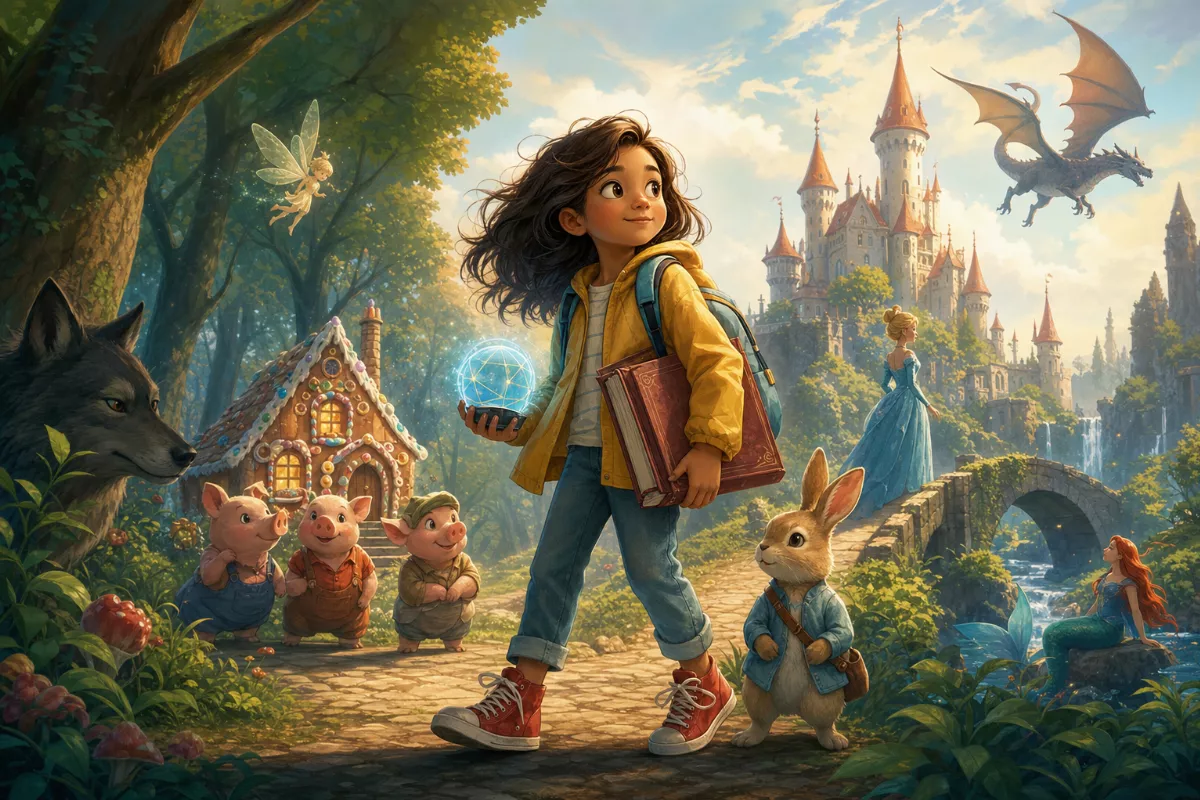
Now the classic fairy tales truly come alive. Children this age love adventure but still need a reassuring ending. Pick stories where the hero is clever or brave, and talk about it afterwards: "What would you have done?" That strengthens thinking skills and vocabulary. This is also a wonderful age for stories set in an enchanted forest, where magic and adventure meet.
6 to 8 years: nuance and opinions
Older children can handle more complex plots and are ready for retellings that turn the classic on its head, such as the story told from the wolf's point of view. They begin to question good and evil and delight in humour and irony. This is a lovely age to talk together about fairness and choices. You will find more inspiration tailored to each stage on our age pages.
The ultimate modern fairy tale: your child as the hero
Perhaps the biggest innovation in children's books today is the ability to make the child the main character. Personalised fairy tales put your child's name, and sometimes their appearance, at the heart of the adventure. Instead of living alongside a prince or princess, your child becomes that hero.
Why does this work so well? Research on reading motivation consistently shows that children listen longer and more attentively when a story is personally relevant. Hearing your own name captures attention instantly. It also supports identity development: a child who sees themselves as brave, clever and resourceful in a story carries a little of that self-image into the day.
A few things to look for when choosing a personalised fairy tale:
- Story quality over gimmick. Slotting in a name is fun, but the story itself has to work: suspense, humour and a satisfying ending. Browse a few examples of personalised books to get a feel for the storytelling.
- Rich, warm illustrations. Children "read" the pictures at least as intensely as the words. Colourful, detailed artwork invites them to keep discovering something new.
- A positive role for your child. Choose stories where the child actively solves something or helps someone, rather than simply looking on.
If you would like to make such a story yourself, you can easily create your own book in which your child journeys through an enchanted forest or meets a unicorn.
Modernising fairy tales at the kitchen table
You do not always need to buy a book to give a fairy tale a fresh coat of paint. In fact, reinventing an old story together is one of the best language games there is. Here is how to do it.
- Choose a well-known fairy tale as your base. Little Red Riding Hood, Cinderella or Hansel and Gretel work well because your child already knows the outline.
- Flip one element. What if Little Red Riding Hood rode a scooter to Grandma's? What if the wolf really just wanted a cheese sandwich? This twist sparks creativity right away.
- Let your child make choices. Ask, "What would the hero do now?" and build the story together. There is no wrong answer, and that sense of ownership is priceless.
- Add familiar details. Set the story on your own street, or give the hero your child's favourite colour. Recognition boosts engagement.
- Always end reassuringly. However wild the adventure gets, close with safety and warmth. That gives your child a calm feeling to fall asleep on.
These storytelling games strengthen vocabulary, story structure and problem-solving. According to language research, children who regularly invent and retell stories carry a clear advantage into learning to read and write. And the best part: it costs nothing more than ten minutes and a little imagination.
How to spot a truly good modern fairy tale
The choice is huge, and not every "updated" version is a success. Some books strip away so much tension that barely a story remains, while others slap on a moral so thick that the fun disappears. Watch for these qualities when choosing:
- The story engages without needing explanation. A good fairy tale tells itself. If you constantly have to explain the point, something is missing.
- There is real suspense and a real resolution. The hero must overcome something. Without a challenge there is no satisfaction.
- The message is woven in, not pasted on. Values like courage, kindness and perseverance land better through characters' actions than through a lecture on the final page.
- It invites rereading. The best books make children want to hear them again and again. That is perhaps the most honest quality test there is.
Still unsure? Read the experiences of other parents first, or browse our ideas and inspiration for stories that go down well at different ages.
The magic stays, the message grows
Fairy tales change with the times, and that is exactly how it should be. They always did, in fact: every storyteller tweaked the tale a little for their audience. What stays the same is the core: the promise that courage is rewarded, that the dark forest has a way out, and that any child can be a hero. Whether you reach for a beautifully retold classic, invent a silly new story together, or make a book where your child plays the lead, you are giving your child something valuable: the experience that stories give strength. And that feeling stays with them for life.
Last updated on
18-07-2026
Table of Contents
- Why fairy tales never go out of style
- What changes in the modern fairy tale?
- The right modern fairy tale for every age
- 1 to 3 years: safety and repetition
- 3 to 5 years: imagination in full bloom
- 6 to 8 years: nuance and opinions
- The ultimate modern fairy tale: your child as the hero
- Modernising fairy tales at the kitchen table
- How to spot a truly good modern fairy tale
- The magic stays, the message grows